Part 1. Origins and arrival in the north
An invitation to contribute to a series of online discussions about Stone in Scotland’s history [1] rekindled some previous enquiries into the long association of corn crops and the stone tools used for cutting the crop and grinding its grain to flour [2].
Introduction
This first article in a set of three explains why corn needs stone, briefly covers the 100,000 year old practice of growing corn and grinding seed for food and relates the journeys of corn from over the world to what is now northern Europe.
Topics in future articles include:
- Arrival of corn crops in Scotland after retreat of the ice
- Change in the type of corn grown and its uses for food and other products
- Stone grinding in Scotland – from querns to powered mills
- Corn and stone – their importance to civilisation and folklore
- End of a partnership? Is there a future for corn and stone.
A note on the word – corn is used here to refer to the seed or the crop of those plant species of the grass family that are commonly known as cereals – including rice, maize, barley and wheat. Their seed is also referred to as grain. These cereals were not present for most of human history, when at various times in various places, people wild-harvested or farmed other grass species. The seed from these wild plants is also referred to as grain.
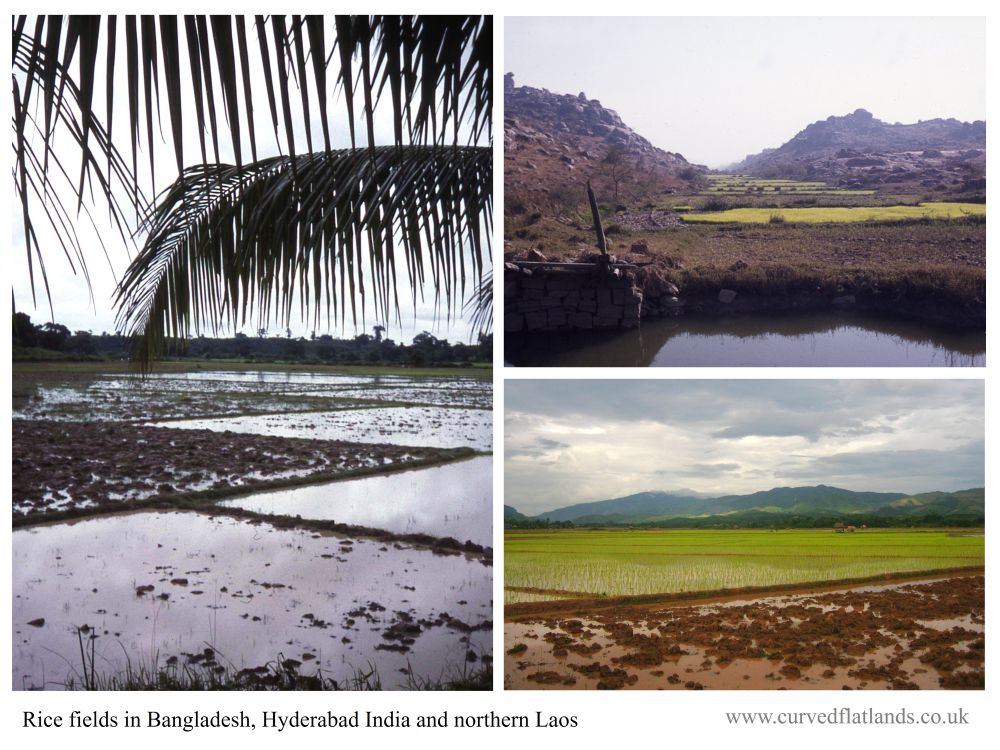
Figure 1. Rice fields in Bangladesh (left), Hyderabad, India (upper right), and northern Laos. Bangladesh and Laos are in the rainy season, fields flooded and prepared for planting; Hyderabad is in the dry season, fields irrigated. Images: Squire @ curvedflatlands.
Of the cereals grown today, rice and maize dominate agricultural land in much of the world’s tropical and subtropical regions (Figures 1 and 2). Wheat and barley, and to a lesser degree oat and rye, are the main crops in temperate or cooler climates. Millets and sorghums are adapted to hot dry conditions as in sub-Saharan Africa.
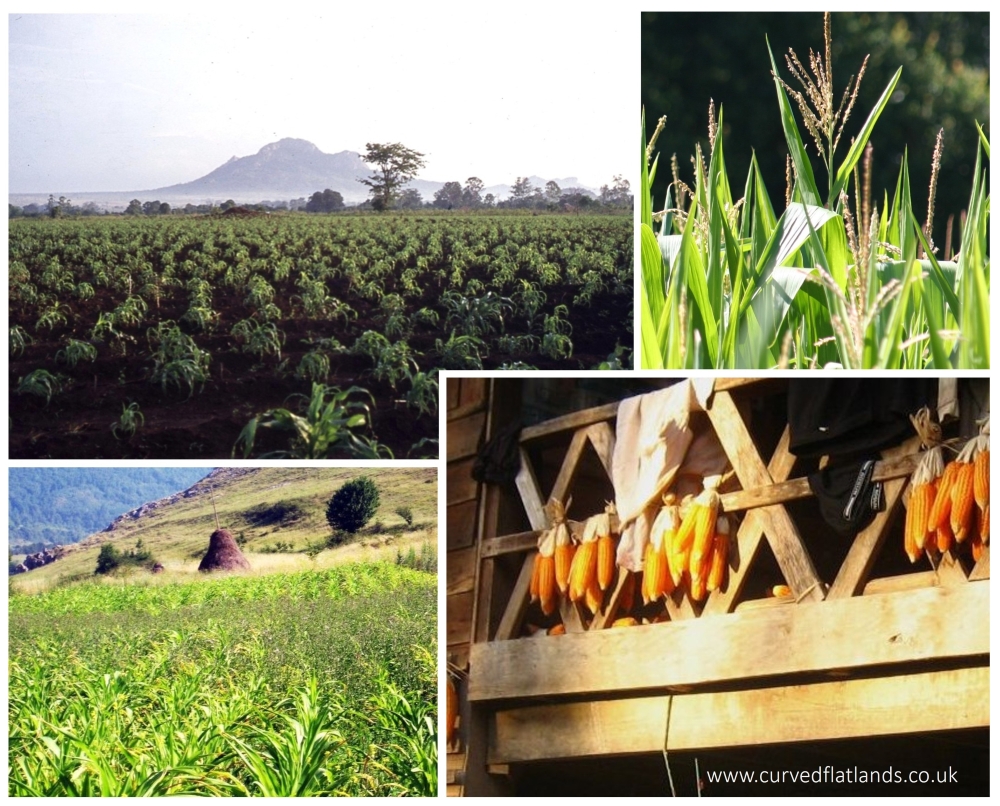
Figure 2. Maize out of the Americas (upper left c’wise): in Mulanje district Malawi, young plants; in Brittany, showing male flowers at the top of the stem; maize cobs drying on a wooden balcony in northern Laos; and maize in contour strip farming, Romania. Images: Squire @ curvedflatlands.
While rice, maize and wheat provide much of the carbohydrate for people and livestock, their rise has been gradual, a tale of trial and error, a sequence broken when civilisations collapse. They have journeyed for thousands of years, across oceans and continents, repeatedly adapting to new environments. More on that below, but first …..
Why corn needs stone
The benefit to people of both wild and domesticated grain crops lies mainly in the seed, which is highly nutritious. Other parts of the crop are also used in various ways, including stems for livestock feed and for thatching. But when dried and preserved, the seed can be carried as societies move around, or stored to be eaten through times of adversity.
The problem is that hard, dry seed is difficult to process, to turn into food. Some such as certain varieties of maize, can be cooked ‘on the cob’, but the seed of most cereals has to be removed from its protective coverings. Dry seed can be softened by wetting it to a state that can be eaten or turned to a drink, but once wetted it soon deteriorates. The only material generally hard enough to remove the coverings and then smash and powder dry seed into meal or flour is stone.
The sequence is much the same today as it always has been. As illustrated in Figure 3 for bere barley [3], plants produce seed on ears held at the top of flowering stems. The ears are harvested when mature and seed separated from the ear by threshing, using variously hand-held implements or complex machinery. The awns – the long, protective bristles seen in Figure 3 (left) – are removed, then the seed is then ground between stones, or sometimes between stone and wood.
The grinding first removes the seed’s outer covering or husk (when it exists) and then converts the seed to a meal or flour. The flour can be stored then made into food by baking or boiling it.
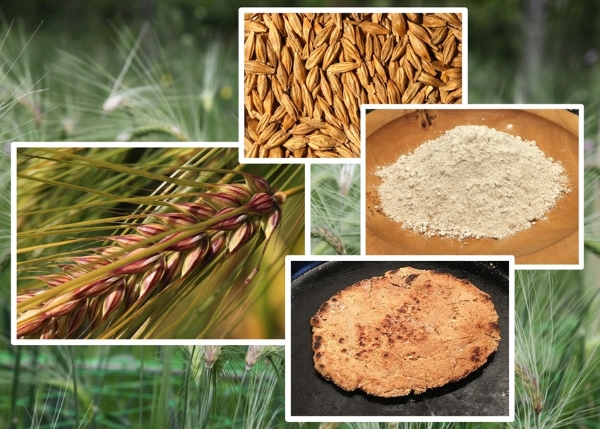
Figure 3. Mature ear of a bere barley crop (left) from which grain (upper right) is threshed, the grain de-hulled and ground into flour (mid-right), and the flour baked into a flatbread (lower right). Bere is a local type of barley once grown widely in Scotland [3] – the background is a field of Orkney bere (Images: @ curvedflatlands).
The procedure in Figure 3 is far from simple. It takes time and skill just to separate clean grain from the crop [4], but the crucial step is using stone to turn grain to meal or flour.
The ancient association of corn and stone
Archaeological studies, for example in East Africa, Australia and Europe are providing evidence that grasses and other plants with hard seeds or roots had been cooked and eaten long before modern cereals appeared, And from the beginning people used carved stone to turn hard plant matter to food.
The map covering Europe, Africa and Australasia in Figure 4 shows dates from some studies that have revealed the early use of stone tools in the preparation of food [5, 6]. (Related work, not shown on Figure 4, has been carried out in the Americas and eastern Asia.) Many different plant species were used for food, notably wild grasses that had the same characteristics of storable, hard seed as the later domesticated cereals.
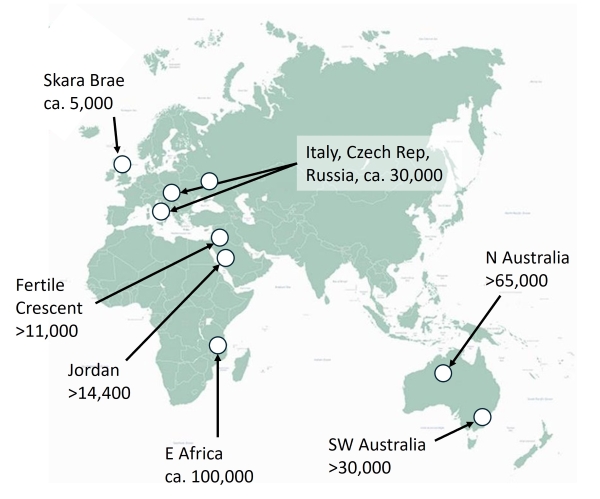
Figure 4. Locations of some archaeological finds revealing the use of stone tools for preparing grain, in Europe, Africa, western Asia and Australia [5, 6]. Numbers show years before the present time. Plant remains at sites before ca. 11,000 years were of wild or semi-cultivated species rather than domesticated cereals such as wheat and barley.
The natural bounty of these plants sustained human life for tens of thousands of years. Their grain and tubers could be stored, then eaten during migration or when fresh food was scarce. The term semi-cultivated as used in Figure 3 is based on evidence – both archaeological, and from today’s indigenous practices – which suggests some of these wild species were ‘farmed’: although the plants were ‘wild’, land was prepared, seed was sown, competition reduced by clearing away other vegetation and produce was harvested [6].
The archaeological evidence shows clearly that prepared stone was used in some cases as a sickle to harvest the plants, but primarily to grind the seed to flour. In Australia, for example, grinding stones have been found at several ancient sites (Figure 5) and many plant species have been used for food. “In Central Australia, for example, native millet (Panicum) and spinifex (Triodia) were commonly used, supplemented by wattle-seed. Elsewhere pigwig (Portulaca oleracea), prickly wattle (Acacia victoriae), mulga (Acacia aneura), dead finish seed (Acacia tetragonophylla) and bush bean (Rhyncharrhena linearis) were mixed into flour.” [6].
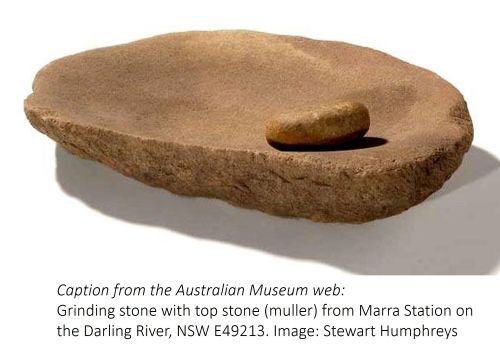
Figure 5. A pair of stones for grinding seeds, from Floreck (2014), on the Australian Museum web [6].
And then today’s main cereals appeared …..
It was one of the main events in human history – the ‘domestication’ of modern cereal crops and their cultivation in settled farming.
Several cultivated species of wheat and barley arose roughly 11,000 years ago in the Fertile Crescent, east of the Mediterranean Sea, including einkorn (Triticum monococcum), emmer wheat (Triticum dicoccum), bread wheat (Triticum aestivum), spelt wheat (Triticum spelta) and barley (Hordeum vulgare). All are still cultivated, but while bread wheat and barley are globally important, the others are more restricted in area, grown for specific products.
Over a similar period, maize was domesticated in the central region of the Americas and rice in eastern Asia. Maize moved overland north and south, and with the advent of sea travel in the last few hundred years, migrated across oceans to other warm climates, Modern genetic lines of these crops supported with high inputs of fertiliser and pesticide can produce some of the highest crop yields. They came to replace many locally adapted species such as African millets and sorghums.
And rice moved from eastern Asia across to Europe, and then by sea to the Americas and Australia. Today, rice is mainly grown in rainy seasons on carefully flooded land (Figure 1), but it can be grown irrigated in dry periods, whereas some varieties prefer to be in soil, un-flooded in fields or on hillsides.
The evolution of farmed cereals for food, both in the Fertile Crescent and elsewhere, was not a sudden transformation. The archaeological evidence referred to above shows the much earlier use of grain from wild or semi-cultivated plants. Even in the Fertile Crescent itself, people had been using stone sickles to cut and harvest wild grasses well before the cultivation of wheat and barley [5], and nearby, in what is now Jordan, evidence was found of bread-baking 14,000 years ago [5].
Migration across Europe
The crops and the knowledge of how to grow them and turn them to food moved slowly, over several thousand years, from east of the Mediterranean Sea across what is now Europe. People and corn migrated north-west across central Europe or west along the Mediterranean and then northwards. The security given by the corn enabled some of the world’s greatest civilisations to grow and flourish.
One example from Ancient Greece shows how corn became embedded in language, beliefs, wealth and commerce. The museum at the archaeological site of Ancient Mycenae in the Peloponnese shows that food crops were given their own ideograms in the Linear B script [7], one of the world’s first deciphered writing systems (Figure 6).
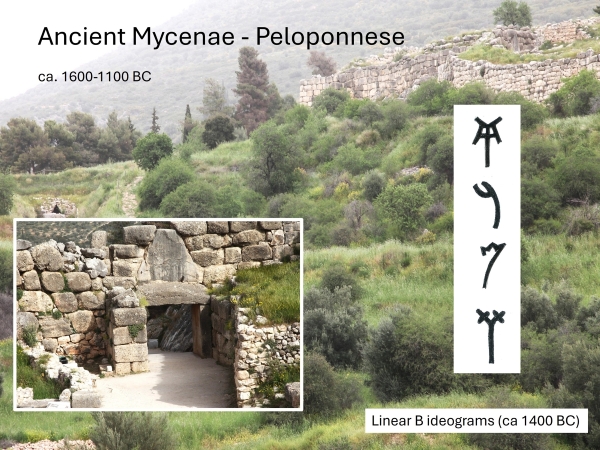
Figure 6. Scenes from Ancient Mycenae on the Peloponnese, and ideograms for (right inset, top to bottom) wheat, barley, olives and figs, contained within the Linear B system of writing [7]. Images taken on site 2013: Squire @ curvedflatlands.
Ideograms such as these represented the word for an agricultural commodity in trade and commerce. The ideogram for barley (second from top in Figure 6, right inset) looks like two glumes or bracts that surround a grain, but that for wheat above it is a little more fanciful.
A few miles from Mycenae lies the massive archaeological site of Ancient Messene. The site held a granary and evidence of an additional use of stone in the processing of corn. Tucked away in a corner of the site is a Mensa ponderaria, a large stone table in which were cut basins of different volume (Figure 7). These tables were used to define measures, not to aid preparation of food, but to act as official standards for people buying and selling grain and other small-seeded produce.
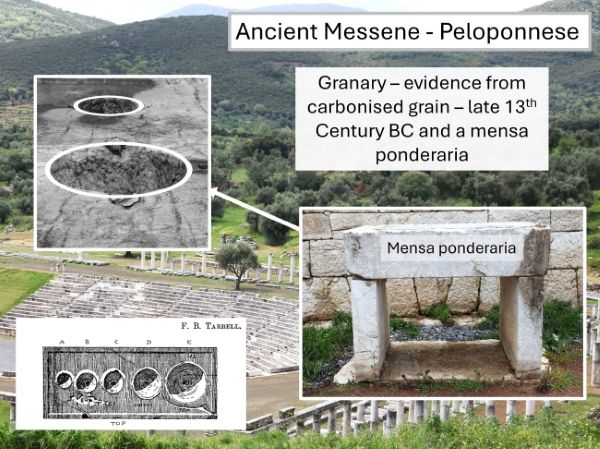
Figure 7. Scenes from Ancient Messene on the Peloponnese with insets showing the measuring device called a Mensa ponderaria (images taken on site 2013: Squire @ curvedflatlands) and (lower left) another example from Assos recorded by FR Tarbell [7].
These examples from one of the greatest civilisations are a statement of the central importance of corn. Its travels continued across Europe, finally reaching the Atlantic shores and crossing to Scotland 5000-6000 years ago. The date of the neolithic village of Skara Brae on Orkney on Figure 4 shows how recently is Scotland’s experience with corn and stone compared to their use in many other parts of the world.
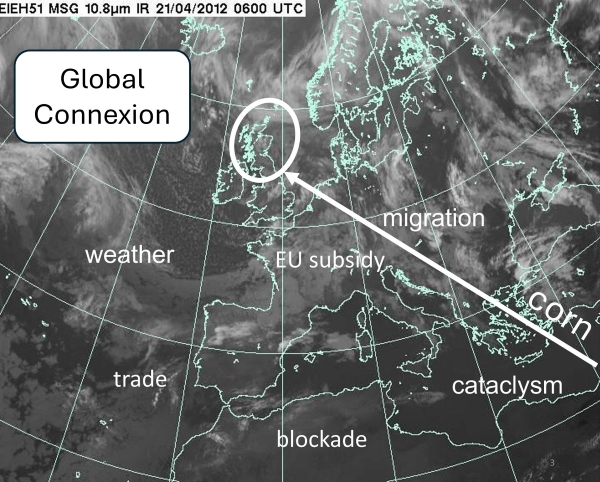
Figure 8. Remote image of Europe with Scotland contained in the oval, the arrow representing the journey of corn crops from the Fertile Crescent; other words represent the external forces that have shaped corn growing and food processing over the millennia.
Adaptation to local conditions – the formation of landraces
The journeying of corn (and stone) was not a single major push. There were waves of migration, each resulting in much trial and error at every traversed and settled locality. Could a corn be grown here? Would it yield enough to feed the people? Could some be left for trade, to make money?
Gradually, over time, each of the corn species diverged into many local forms known as landraces. Seed was saved from one year to the next and gradually became adapted to the climate and soil of a locality and also to specific needs of food and livestock feed. Whether originating in the Fertile Crescent or on the other side of the Atlantic, all corn existed as landraces for thousands of years. Where are they now?
Today, farming buys most of its seed from specialist companies that select, breed and propagate named varieties using highly technical methods to ensure uniformity, resistance to disease and high yield potential. Over the last 150 years, modern crop varieties have ousted landraces in much of agriculture.
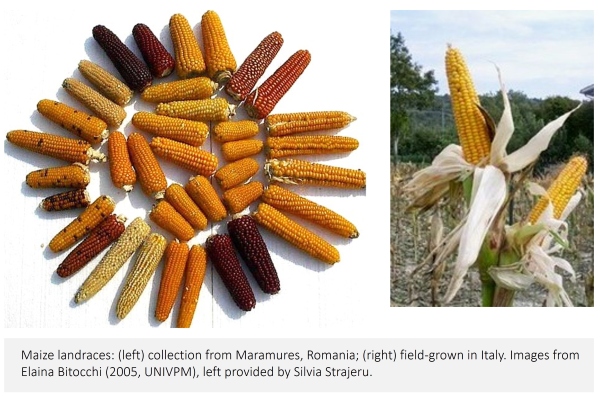
Figure 9. Collection of maize cobs from different landraces still grown in the Maramures region of northern Romania (left) and a landrace in an Italian field. Links to work by Elaina Bitocchi, Roberto Papa and colleagues at reference [8].
Are they all gone? No, landraces still exist in 21st century Europe, where they are commonly grown for highly valued local food, and hence retain cultural links to past centuries. For example, surveys in a EU-funded project published 2008 found many landraces of maize (Figure 9) were still grown in more than fifteen countries of south and central Europe [8]. More than half the landraces were grown for human food and the rest for livestock feed and several other products.
Not all corn has fared so well. In contrast, only one barley landrace is grown in Scotland, and that until recently in only a few fields in Orkney [8].
The story continues
The arrival of the various forms of wheat, barley, rye and oat in the north-east Atlantic region had lasting impacts on the development of land use, agriculture and wider society. The migration of corn is one of many external forces and influences on the region that include distant cataclysms bringing tsunami, volcanic eruption and radioactivity, also diseases harming people, plants and livestock, and not least the vagaries of trade due to war and blockade. Yet corn cultivation has enabled the people to withstand and recover from all such external forces.
And of course the weather, in Scotland ….. which tends to come from somewhere else, out of our control …… and which gets a bad name for being so changeable and unpredictable. But when compared to most other agricultural regions of the world, that weather is ideal for the cultivation of corn crops – as will be considered in next article in this series.
Contact: curvedflatlands@outlook.com
Part 1 first published in February 2026 then extensively revised in August 2026.
Part 2. The arrival of Corn (and Stone) in Scotland; developments in grinding stones from querns to water powered mills; developments in corn crops, their yields and products up to the last century.
Sources | Links
[1] Thanks to Magdalena Blazusiak of Robert Gordon University (RGU) for the invitation to contribute to Stone Futures 4 – Stone Stories, held online 2 February 2026 as part of a series of talks titled Stone Futures, organised by the Chartered Institute of Architectural Technologists (CIAT), Scottish Ecological Design Association (SEDA), and Historic Environment Scotland. Geoff Squire joined Amy Wilson (RGU) and Magdalena Blazusiak to give presentations and discussion at lunchtime on 2 February. Further information on the session is given at the CIAT and SEDA web sites, where there are also links to the recording.
[2] The author of this article, Geoff Squire, has a long interest in various forms of corn and their influences on the world’s managed ecosystems. He worked in the 1970s and 1980s on the – millet and sorghum in the semi-arid tropics and to a lesser degree maize – and also our local wheat; then continued from the mid-1990s to investigate barley, oats, maize and wheat mainly in Scotland but also in other parts of the UK and Europe. Recent open-access papers covering corn crops in the ecosystem include: Squire, Hawes (2024) Biodiversity for agriculture: the role of integrated farm management in supporting agricultural production through biodiversity. Book Chapter BDS Publishing: link to free download; and Squire, Young, Banks (2023). Post-intensification Poaceae cropping: declining soil, unfilled grain potential, time to act. Photographs in Figure 1 and 2 were taken during work and travelling in various parts of Africa and Asia between 1973 and 2010.
[3] Part 2 of Corn and Stone will examine the arrival and development of corn and stone in Scotland. Further information on corn growing here is available at both curvedflatlands and Living Field web sites. The link to the Bere line-rhymes with hairline leads to a range of articles on cereal species and landraces, traditional food from local corn, the effects on yields due to recent climatic shifts and wars (e.g. Global wheat – status now) and wider views of crops not grown here such as Rice.
[4] Traditional methods of converting grain to flour The steps in separating ears and stem in cereal plants, and then removing the awns and ‘hull’ (outer covering) around the grain need specialist knowledge and machinery.
The following online article considers the methods and equipment for taking the hull off grains of the early cereals, emmer, spelt and einkorn. Baker, B. (2015) Dehulling ancient grains: economic considerations and equipment. eOrganic web article available at https://eorganic.org/node/13028. This study was in response to the revival in some areas of some of the first corn species to be domesticated 10,000-12,000 years ago that had fallen from widespread usage.
In the UK, Seed Sovereignty with the Gaia Foundation is active in promoting knowledge of local varieties and methods of small scale processing of corn crops. The following article is available online: Croft Scale Equipment used to process grain. A historical perspective and route to revival – PDF file. The first paragraph reads “The Gaia Foundation is an international charitable organisation with 35 years working alongside Earth’s best custodians and defenders. Seed and food sovereignty for climate change resilience is a central pillar of Gaia’s work. To achieve that work on our islands The Seed Sovereignty UK and Ireland Programme was formed within Gaia to support a biodiverse and ecologically sustainable seed system across Britain & Ireland.”
[5] Scientific articles on the archaeological evidence for the use of stone tools to process seed and corn. Most articles are available for free download from the links given to a journal’s web site. In alphabetical order of first author.
Clarkson, C. et al. (2017) Human occupation of Northern Australia by 65,000 years ago. Nature Vol 547, doi:10.1038/nature22968
Maeda, O. et al. (2016). Narrowing the harvest: increasing sickle investment and the rises of domesticated cereal agriculture in the Fertile Crescent. Quaternary Science reviews 145, 226-237.
Revedin, A. et al. (2010) Thirty thousand-year-old evidence of plant food processing. PNAS 107 (44), 18815-18819. http://www.pnas.org/cgi/doi/10.1073/pnas.1006993107
[In progress: to be continued.]
[6] In Australia, Anthropologists are reassessing the use of wild and semi-cultivated plants before modern cereals became dominant. Here are some links that describe archaeological sites, indigenous practice, plant species harvested, and stone grinding tools used to convert seeds to meal or flour. The first two papers below give reference to numerous publications which draw attention to the wide range of plant genera and species that have been and still are used as food.
Drake, A., Keitel, C., Pattison, A. (2021) The Use of Australian Native Grains as a food: A review of research in a global grains context. Rangeland Journal 43, 223–233
Jenifer, J., Bell, T.L., Khoddami, A., Pattison, A.L. (2023) Panicum decompositum, an Australian native grass, has strong potential as a novel grain in the modern food market. Foods 12, 2048. https://doi.org/10.3390/foods12102048
The following are shorter reads from Australian Museum web sites. Articles generally give pointers to further reading.
Floreck, S. (2014) Food culture: aboriginal bread. Australian Museum web site: https://australian.museum/blog-archive/science/food-culture-aboriginal-bread/ The quote above Figure 5, describing wild species used for food, is taken from this article.
Australian Museum (2021) Wailwan grindstone. https://australian.museum/learn/first-nations/unsettled/unsettled-introduction/wailwan-grindstone
Wheeler, H. 2022. Grindstones. Australian Museum web: https://australian.museum/learn/cultures/first-nations-collections/cultural-objects/grindstones/
[7] Ancient Mycenae | Ancient Messene | Linear B | Mensa ponderaria Wikipedia gives much information on the two ancient archaeological sites of Ancient Mycenae and Ancient Messene. Both are UNESCO World Heritage sites described on the UNESCO web at Mycenae and Messene.
On Linear B, the Wikipedia web gives a history of the script and lists the phonetic signs and ideograms, the latter, like wheat and barley, indicating items for farming and trade. For the Mensa ponderaria: more photographs and links on the Living Field web at Grain measures in Ancient Greece.
[8] Maize landraces. The work referred to on maize landraces in the text and Figure 8 was by Elaina Bitocchi, Roberto Papa and their colleagues at Universita Polytecnica delle Marche (UNIVPM), Italy, as part of the EU-funded SIGMEA project (workpackage coordinated by GS). Elaina was a doctoral student at that time. Thesis reference: Bitocchi E. 2008. Genetic diversity and introgression in maize landraces from central Italy. PhD thesis, Università Politecnica delle Marche, Ancona (UNIVPM).
[9] Scotland’s bere barley landrace is currently being researched at the James Hutton Institute, Dundee, UK, which has established a bere growers’ network: further information on the Living Field web at Bere barley participatory network.
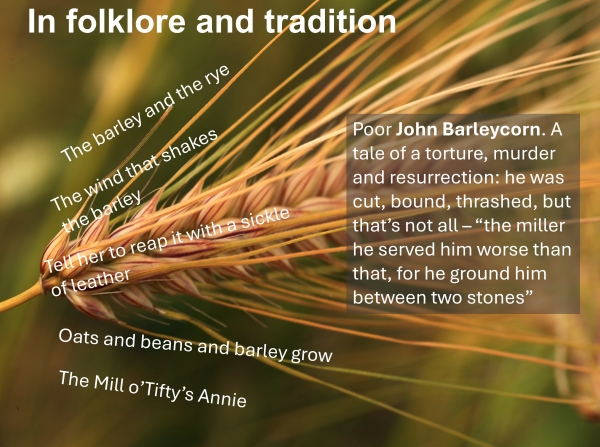
And finally … A maturing ear of the landrace bere barley adorned with lines from various folk songs that include mention of corn crops, usually barley, and milling; and inset the apocryphal tale of the death and resurrection of John Barleycorn.