
Roadside verges and hedges. Regenerating biodiversity. Wildlife corridors. Welcome increase in species locally. Destruction at peak flowering in early June. Further scouring by ultra-wide harvesters in late July. The wider context of rural industrialisation. Questions remain.
In the blog Verge-mageddon [1], we noted the destructive effect on roadside plants of an early verge-mowing in June when the plants were about to reach peak flowering and make their floral contributions to ecological food webs.
Then a few weeks later, on 26 July 2026, just when some of the plants showed signs of recovery, the verges were flattened and scoured as a convoy of massive harvesting machines and their attendant tractors and trailers ground their way slowly along the road (Plate 1).
The vehicles left tyre tracks on the roadside verges that indicated a span of 3.5 meters between the outside of the wheels, and in some places the track left by the passing of several vehicles spanned 4 metres. In stretches of road where the tarmac was 2.6-2.8 metres wide, they had to drive with their wheels on both verges, missing the tarmac altogether. In some places, around half the verge was flattened or scoured.
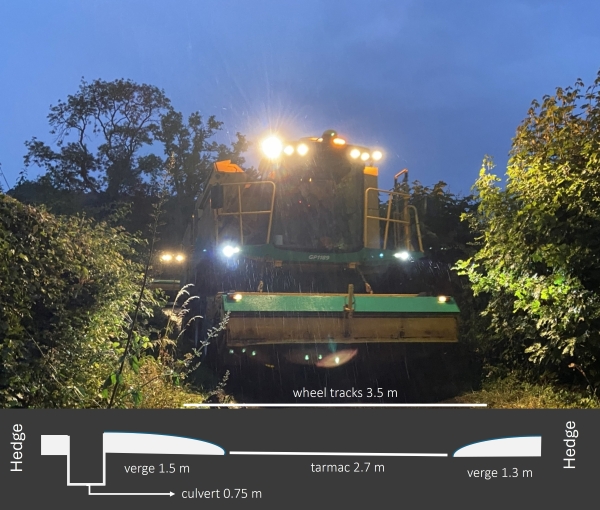
Plate 1. Convoy of harvesting machines and vehicles moving down a U-road, leaving tracks spanning 3.5 m; diagram below the image shows the widths between the hedgerows of tarmac, verges and a Victorian-era drainage culvert. (Images: curvedflatlands).
What were they?
Farm vehicles of this great width are most likely OXBO harvesters. The OXBO web site gives specifications of some very wide vehicles, including pea combines and potato harvesters. For example, the GP6300 Pea Combine has a width of 3.5 m, or 4.0 metres with ‘picking head’ included. And the GP1139 Self-propelled pea harvester is available in widths from 3500 to 4000 (3.5 to 4.0 metres).
And yes this is farmland , and it’s good to see fields of peas and other grain legumes in the landscape. They fix their own nitrogen with the help of bacteria in the soil, and so improve fertility and reduce greenhouse-gas emissions from agriculture. And the technology in these pea (and potato) harvesters is stunning. The OXBO web claims that ‘every pea matters – more peas in the hopper and more peas to the plant’ which refers to the machines being highly effective in not leaving peas behind in the field – a fair claim, since walking a pea field after a recent harvest found few peas or even empty pods on the soil surface. Their advanced tech also helps reduce in-field soil compaction which is one of the major current causes of soil degradation and loss in arable landscapes. Of the GP6300, the OXBO web sites states “The significantly lower weight per wheel translates into less field compaction and better performance in wet conditions.”
Yet the tech is nowhere near designed to protect or preserve soil and land outside the field. On narrow country roads, they have the capacity to severely compress, gouge out and in some places more or less destroy roadside verges, initiating a chain of environmental consequences that persists for years.
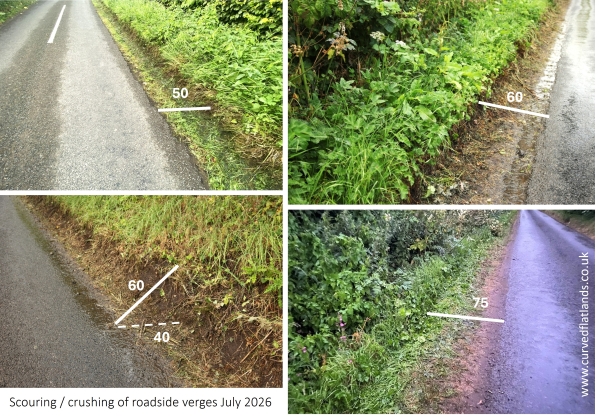
Plate 2. Vergemageddon 2 – the aftermath. Sections of roadside verge: upper left and right, verge compressed to below level of tarmac, forming erosion gulleys; lower right, more than half the verge-width compressed; lower left, sloping bank scoured and removed. Dimensions in centimetres. Images: www.curvedflatlands.co.uk.
Long term effects
The passage of machines down this narrow road severely compressed the soil and remaining vegetation on both verges, in some places scouring off the upper layer of soil (Plate 2). The soil compaction and scouring initiates a sequence of environmentally negative processes in addition to the loss of plant diversity and food webs described at [1].
First, the verges hold less water. The compressed soil has less free space in it, so rain falling on the verge runs onto the road, and less of the rain falling on the road percolates into the verge. In consequence, more rainwater runs down the tarmac.
Second, the bare soil is easily eroded and moves onto and down the tarmac with rainfall. The soil clogs the roadside drains, causing even more water to run down the tarmac. The moving soil and water flood the road where it levels.
Third, the compacted, bare soil also holds less air and is harder for roots and microorganisms to penetrate. The soil recovers slowly if at all, needing but not getting the re-growth of the fungi and other microorganisms that bind mineral particles and organic matter. The soil remains liable to further damage by winter freezing cycles and heavy rain.
Fourth, the bare soil, bereft of its usual covering of plants, is open to receive seed and vegetative fragments from outside the area – including invasives like Giant hogweed, Himalayan balsam, and Japanese knotweed [3]. They’re not far away!
And so the destruction extends and ramifies.
Ed: this is one of a series of articles on the industrialisation in the ancient agricultural landscape of the Carse of Gowrie and the Sidlaw Hills between Perth and Dundee. More to follow.
Contact: curvedflatlands@outlook.com
Sources | Links
[1] The first instalment of the Vergemageddon series – Verge-mageddon in June – was written following an early mowing of the verge that affected most of the flowering plants.
[2] OXBO International: https://www.oxbo.com gives full specifications of pea and potato harvesters and many more machines. Author’s note on decimal convention: the OXBO web gives the decimal point sometimes as a comma and sometimes as a stop, e.g. 3,5m and 3.5m, whereas the comma in UK usage is usually the thousand-separator, e.g. 3,500. It is presumed that the comma in 3,5m (for example), is the decimal point (so 3.5 metres).
[3] Information on Non-native invasive plants: at NatureScot ; Royal Horticultural Society; for a deeper dive, GB Non-native Species Secretariat has sections specific to Scotland.
Postscript. The day after the event, a contact of a contact related a chance meeting with a local mystic, who said they had witnessed a party of red squirrels hopping along the road. They were on their weekly parade, carrying placards with messages like “Better red than dead” and “No pox here” to warn young ones of their kind and others of the dangers facing them.
As they hop along, they chant, says the mystic, and (being well into 1980s rock) one of their common refrains is based on a Def Leppard track …. those at the front shouting “Are you gettin it” and the ones behind replying “Yes Armageddon it”. The mystic said the reference to Armageddon was the squirrels’ defiance of the current terminal threats to the reds and much other wildlife. But on 27th July they modified the sequence just like this:
Are you gettin’ it
Yes Armageddon it
Are you really gettin’ it
W’e verge-mageddon it.