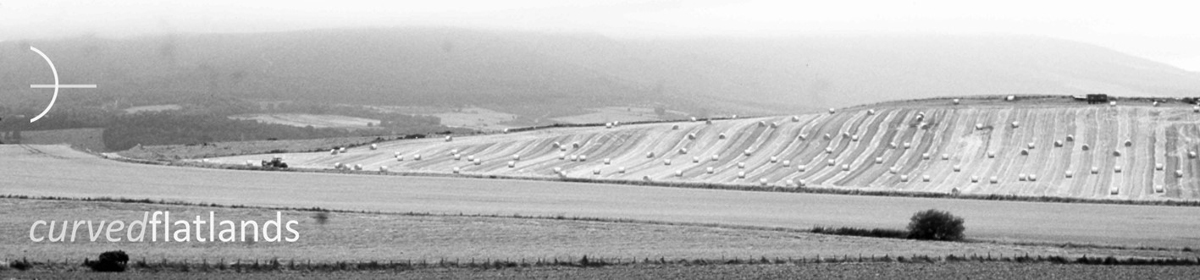
Roadside verges and hedges. Regenerating biodiversity. Wildlife corridors. Welcome increase in species locally. Destruction at peak flowering in early June. The wider impact of rural industrialisation. Questions remain.
Context
Planning has been consented for a solar power station on the Sidlaw Hills between Dundee and Perth. Further planning is proposed for massive solar power and battery stations in land below the Sidlaws, in the Carse of Gowrie.
Both projects are likely to have detrimental effects on biodiversity and landscape connectivity for wildlife in the region. As in most of the world’s countries, biodiversity continues to decline in Scotland, often through cumulative small events that seem to have little importance in themselves.
In that context, this article looks at what would seem to be a minor impact – that on plant biodiversity caused by mowing of roadside verges at peak flowering time in June. The narrow road in question is one of many that are likely to be affected during construction of the power plants.
So what’s the problem …. it’s just a grass a verge ….
The latest UK survey of plants by the Botanical Society of Britain and Ireland [1] tells how “….. the Scottish flora has changed over the last century, particularly the spread of non-native species and negative impacts of land management, pollution, and climate. These findings provide a powerful evidence-base for nature recovery, conservation and research, and highlight the changes needed to protect, restore and enhance the Scottish flora in the decades ahead.”
And in the general declines in biodiversity, a crucial habitat for plants in 21st century UK is that of the roadside verges and hedges [2]. Verges and hedges are immediately visible to walkers, riders and motorists, who might take assurance, even pleasure, from seeing ‘nature’ close by. The verge plants sustain the underground microorganisms that make and renew soil, and offer food, housing and safe passage for many invertebrates, amphibians, birds and mammals. And in many areas, roadside verges and hedged make wildlife corridors that allow living things to move around the landscape.
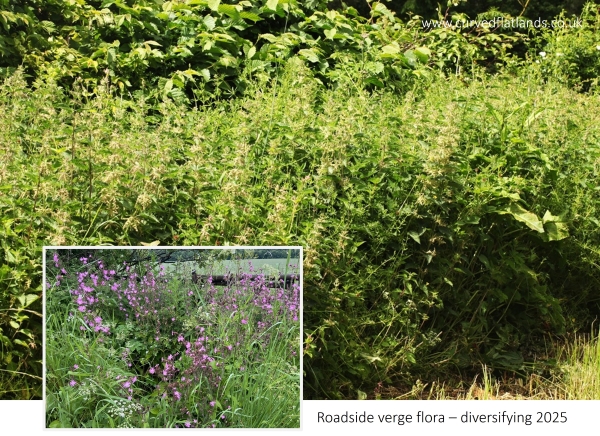
Plate 1. Typical high-nutrient, roadside verge dominated by stinging nettle, dock and cleavers; compared to (inset) a patch of flowering red campion and cow parsley, two of many species that have spread in recent years to give functional diversity and colour to verges in this area. (Images: curvedflatlands.co.uk).
The destruction of verge soil and flora here can be viewed as another drip adding to the flood. Globally, biodiversity is in crisis. Yet all people, communities, regional authorities and governments can act to restore and protect the plants, microbes and animals that sustain life on earth.
Surprising regeneration of wildlife corridors
Many roadside verges in the UK have been degraded through lack of care, poor management, pollution, and an excess of nutrients that encourages domination by a few, typically nutrient-hungry, plants – mostly stinging nettles, docks, thistles and cleavers. These agricultural ‘weeds’ are now rare in the surrounding fields, but thrive on nutrient-rich, unploughed verges.
Yet local people in a part of Perthshire, UK have noted some change in recent years along a rural, single-track road stretching a few miles north from the Carse of Gowrie up towards the Sidlaw Hills. The roadside vegetation, previously dominated by the nettles and docks, had given way to a more diverse flora [Plates 1, 2]. People using the road were pleased with the emergence of colour and scent in summer, for example the swathes of red campion, sweet cicely, meadowsweet and cow parsley. Below and among them, scattered here and there, were more than 50 other plant species [3], including pilewort, cuckoo-pint, field scabious, bluebell, bladder campion and blue sowthistle.
These plants form a collective that sustains many other creatures above and below ground, including bees and butterflies and birds such as the bullfinch and goldfinch, but also the unseen, microscopic life that keeps soil intact and degrades pollutants.
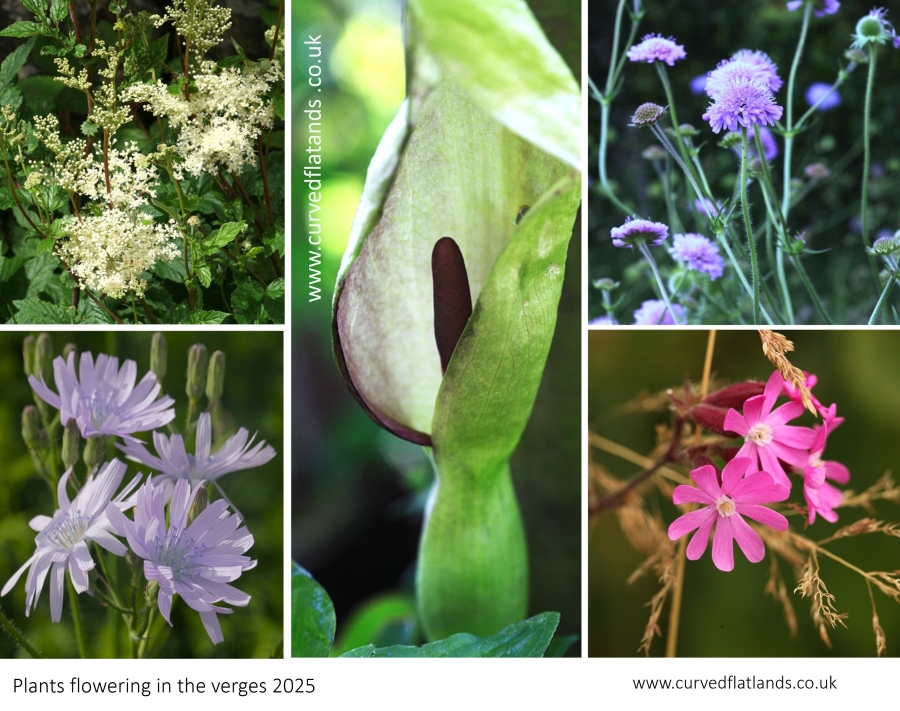
Plate 2. Newly thriving on the verges (top left, clockwise): meadowsweet, lords and ladies, field scabious, red campion and blue sow-thistle. (Images by Squire @ curvedflatlands).
The diversified verge flora here combined with species-rich hedges and a roadside drainage system to create a wildlife corridor linking the Carse of Gowrie to the higher land. In parts, the drainage takes the form of a stone culvert – built in the Victorian era – running along one side of the road between hedge and verge. The corridor of verge, hedge, mature trees and wet culvert provided not only local food and habitat, but a channel for movement of plants and animals. A recent example is the spread of cuckoo-pint (lords and ladies, Arum maculatum) along the corridor, probably dispersed in the seasonal flow of water.
The corridor is also a route taken by invertebrates and amphibians and by mammals such stoat and hedgehog, and offers a temporary refuge for the brown hare and red squirrel that sometimes use the tarmac in their journeying.
Notably, of the plants now appearing in low frequency are several wild legumes – species that, with the aid of bacteria living in the soil, fix nitrogen from the air into their root system. They tend to prefer, and are indicators of, low-nutrient environments, where they in turn offer a feast to a range of ‘bugs and beasties’ that live in the soil and air. These legumes include red and white clover, meadow vetchling, tufted vetch, bush vetch, bird’s-foot-trefoils and restharrow.
Reasons for such diversification in plant life are uncertain but possibly include a decrease in run-off of nutrients from higher ground, less atmospheric deposition of nitrogen, shifts in weather patterns and later verge-mowing by the local authority.
Destruction – for what reason?
So this year, as May led into June, the verges held glorious swathes of red campion mingled with the white of cow parsley and sweet cicely. Meadowsweet was about to release its fragrance. The arum lily’s berries were just turning to red, and orpine’s flower heads were about to emerge on their succulent stems. Wild strawberry was fruiting in more open spots and the small blue flowers of speedwells and ground ivy were poking through the higher foliage. Isolated clumps of field scabious, vetches and vetchlings were about to offer their nectar and pollen to the local wild bees.
By World Environment Day on 5 June the verges were resplendent. But what’s World Environment Day? The UN web says “World Environment Day reminds us that we still have time to change course. The Earth is sending us signals. The question is: what signal are we going to send in return?” [4].
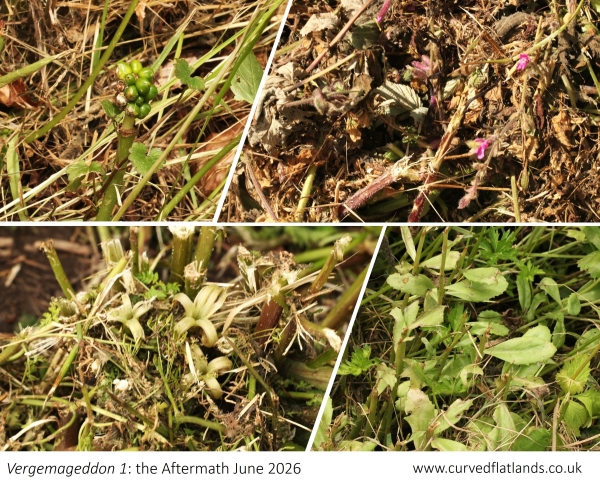
Plate 3. Vergemageddon – the Aftermath 1. Verge plants after mowing in the first week of June 2026 (top left, c’wise): cuckoo-pint, its berries green but turning to red; red campion, in glorious full flower, replacing stinging nettles over long tracts of verge; orpine, leaves and stems well grown in readiness for flowering; and sweet cicely (Myrrhis odorata) flowering, filling its seeds and filling the air with aniseed scent. (Images: curvedflatlands.co.uk).
On 6 June, the verge ecosystem was destroyed in a few minutes of verge-mowing. Almost all the flowering legumes were cut – there was nothing left for the pollen-feeders. The effect will be felt down the line: from late June onwards, plants would normally be seeding and storing their hard-won carbon and nutrients ready for the coming winter and next year’s emergence. Many of them will not have the time to re-grow and store. And from the human view, locals would not now see many of these plants in flower for another 12 months.
Not all plants were destroyed. Some were fortunate to grow over a metre from the tarmac, close to a hedge, which was mostly untouched. Others are small enough to avoid the blade, perhaps living in a dip in the ground, like the wild strawberry and ground ivy in Plate 4. Most of the other 50 or so species will re-grow and potentially seed in 2026.
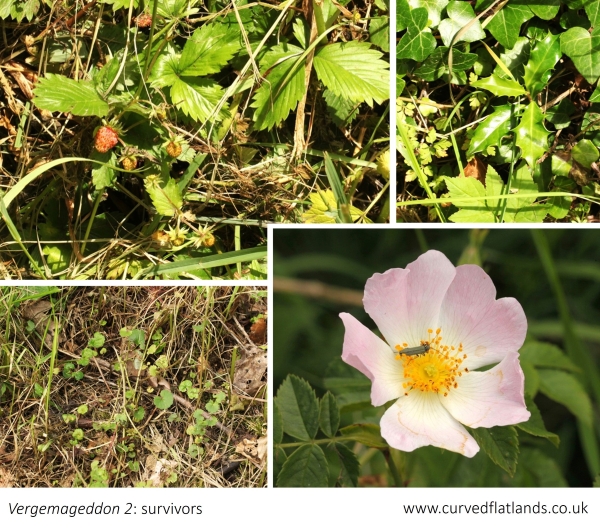
Plate 4. Vergemageddon – the Aftermath 2. Some survivors (top left c’wise), wild strawberry missed the blades in a dip; holly seedling; wild rose intact, hanging from the adjoining hedge; and ground ivy, about 3 cm tall. (Images: curvedflatlands.co.uk).
But why – ask many people from the local community – were the verges smashed at their peak in early June? The Council were already aware of the importance of these verges as part of a wildlife corridor [5]. One resident asked the Council for an explanation and was told it was for the purpose of road safety. But the hedges and verges along this stretch do not for the most part encroach on the tarmac at this time of year and verges are not the main hazards for pedestrians, dog walkers, cyclists and horse riders. Or was this early-June verge-mowing linked to wider, ongoing threats to the safety of these U-roads due to other reasons presented above. (More on this via a later curvedflatlands blog).
Hey | You | Get Offa Ma Cloud Road !
The problem has many roots. Yes, this is farmland and farm vehicles have become heavier and wider, but for the most part, local farm traffic knows the road, is part of the community, and generally considerate of others.
There’s a more widespread problem of traffic on rural roads where there are far more deaths per vehicle or per miles travelled than on motorways and A-roads [6]. More generally, among the main hazards on rural, single-track roads are impatient motorists in all kinds of vehicles who expect walkers, dogs, cyclists, riders to get off, to get out of their way. And according to national records, quite a number of such drivers having been diverted off wide but congested major roads by their sat-navs, and are annoyed and frustrated at the narrowness, bends and limited visibility of single-track country lanes [6].
Whether the drivers are safe and considerate or otherwise, the question is asked – where is ‘off’ the road. And the answer in most places is the verges. The ground beneath the verge vegetation tends to be uneven in places and where covered in chest high stinging nettles and spiny thistles may be difficult to enter. So there is some justification in mowing on grounds of safety.
There has to be a balance between ensuring safety and restoring much-depleted biodiversity. Yet the need for safe spaces for people, dogs, bikes and horses should not require indiscriminate cutting of all verge vegetation over a few kilometers. Cuts just 2 or 3 metres long could be made every (say) 50 metres or so, especially where the nettles dominate. And there is no reason to cut vegetation where the verge is a steep slope which most pedestrians, etc. would not use in any case.
Plants are more than names
This mowing in June may be just one incident in one year along one stretch of minor road. Surely it’s of little importance! None of the species noted under sources below is in danger of extinction. Yet many of them are in decline – a trend often caused by many of these seemingly small, local events, scattered over the countryside. Over time decline leads to rarity and then to extinction.
Many of these plant species will together support a wide range of ecological functions Their simultaneous loss will have many knock-on negatives for all sorts of other creatures …… including people. For example, the nitrogen-fixers – the vetches, vetchlings, trefoils, clovers and other legumes – will offer no further nutrition to bees and many other insects in the coming summer and autumn (Plate 5). The plants also collectively bring benefits to road users by reducing water flows along the tarmac and the erosion of soil.
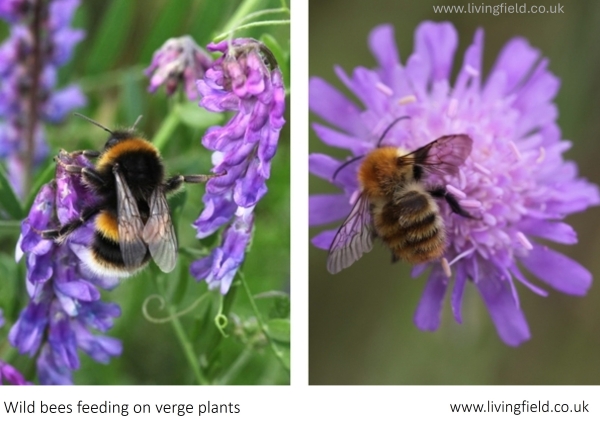
Plate 5. Wild bees on tufted vetch (left) and field scabious. Photographs taken in a previous year a few miles from the site by www.livingfield.co.uk.
Questions remain unanswered over the management of wildlife corridors in this area, in particular the early June mowing of 2026, and then the scouring of the verges by massive agricultural machinery in late July (see Vergemageddon 2 – the machines! the machines !). These events gain importance as part of a much wider context – that referred to earlier of the industrialisation of ancient landscapes in the Carse and Sidlaws.
More to follow.
Authors: Geoff Squire and Kathryn Squire, with information from many local residents concerned about biodiversity-loss and road safety. Contact: curvedflatlands@outlook.com
Sources | Links
[1] Botanical Society of Britain and Ireland (BSBI). The major surveys by the BSBI give an authoritative account of state and change in the UK’s plant life. The quote in paragraph 2 is from the Summary report for Scotland and continues with the following lines “These measures include better protection for plants, the restoration of the ecological conditions that they need, managing land more sustainably, putting plants at the centre of conservation schemes, strengthening monitoring and surveillance, and raising awareness of the threats plants face and the vital role they play in our daily lives.” BSBI sources: Introduction to Plant Atlas 2020 at https://bsbi.org/plant-atlas-2020; Atlas online at https://plantatlas2020.org; and Summary report for Scotland published 2025 here.
[2] Plantlife gives information on the importance of verges as biodiversity refuges and wildlife corridors, plus advice and guidance on their management: see ‘Managing road verges and green spaces’ online at https://www.plantlife.org.uk/learning-resource/managing-road-verges-and-greenspaces/
[3] Plants of the verge. Despite the dominance in many stretches of stinging nettle (Urtica dioica), dock (Rumex obtusifolius), thistle (Circium arvense) and cleavers (Galium aparine), the verges described here provide habitat for many other species. The following, more than 50 species, are some of those noted over the past year or two while strolling along the lane (i.e., not from a formal botanical survey). There will be many other species, which will be added when remembered.
First, some dicot (broadleaf) species and couple from the Lily family. Since many species have more than one common name, and to assist readers from other countries, species or genera are listed in order of botanical or Latin name. Aegopodium podagraria (ground elder); Ajuga reptans (bugle); Alliaria petiolata (garlic mustard); Anthriscus sylvestris (cow parsley); Arum maculatum (lords and ladies, cuckoo-pint); Bellis perennis (daisy); Centaurea nigra (common knapweed); Cicerbita macrophylla (common blue-sowthistle); Digitalis purpurea (foxglove); Filipendula ulmaria (meadowsweet); Fragaria vesca (wild strawberry); Geranium robertianum (herb robert); Glechoma hederacea (ground ivy); Heracleum sphondylium (hogweed); Galium verum (lady’s bedstraw), Geum rivale (water avens); Geum urbanum (wood avens); Geranium robertianum (herb robert); Heracleum sphondylium (hogweed); Hyacynthoides non-scripta (bluebell); Fragaria vesca (wild strawberry); Glechoma hederacea (ground ivy); Hypericum family (various St John’s-worts); Knautia arvensis (field scabious); Lapsana communis (nipplewort); Lathyrus pratensis (meadow vetchling); ); Leucanthemum vulgare (oxeye daisy); Lonicera periclymenum (honeysuckle);Lotus corniculatus (bird’s-foot-trefoil); Matricaria discoidea (pineappleweed); Myrrhis odorata (sweet cicely); Ononis repens (restharrow); Plantago lanceolata (ribwort plantain); Plantago major (greater plantain); Primula veris (cowslip); Prunella vulgaris (selfheal); Sedum telephium (orpine); Ranunculus ficaria (lesser celandine or pilewort); Ranunculus repens (creeping buttercup); Silene dioica (red campion); Senecio vulgaris (groundsel); Silene latifolia (white campion); Silene vulgaris (bladder campion); Scrophularia auriculata (water figwort); Sinapis arvensis (charlock); Sonchus oleraceus (smooth sowthistle); Stachys sylvatica (hedge woundwort); Torilis japonica (upright hedge-parsley); Taraxacum complex (dandelion); Veronica species (various speedwells); Trifolium pratense (red clover); Trifolium repens (white clover); Vicia cracca (tufted vetch); Vicia sepium (bush vetch).
Now to the grasses, horsetails and ferns. The grass family here includes Arrhenatherum elatius (false oat-grass); Avena sativa (wild oat); Dactylis glomerata (cocksfoot); Holcus lanatus (Yorkshire fog) and one or more species each of Alopecurus (foxtails), Agrostis (bents), and Poa (meadow grasses). Must consult Hubbard! There are one or more horsetail species (Equisetum) and several ferns which we must identify … !?
[Authors’ note: The Botanical or Latin names of species sometimes change as new information arises about their genetic heritage. Some of the above names are not the latest!]
[4] World Environment Day, sponsored by the United Nations, is the largest global platform for environmental public outreach and is celebrated by millions of people across the world. It is held on on 5 June each year: https://www.un.org/en/observances/environment-day
[5] Communication by Kathryn Squire: Reduction in Biodiversity in Knapp Conservation area, 2 April 2026, to local Councillors from Perth and Kinross Council (PKC), PKC Officials and Councillors from Angus Council.
[6] Observer, 11 June 2026. Drivers urged to ignore satnav diversions by Neil Lancefield. A short article in a Sunday newspaper on the dangers to human life on rural roads. It tells of the finding by road safety charity IAM Roadsmart that more than half of drivers had said they were diverted to rural roads due to congestion. The context is that more deaths occur on rural roads despite lower traffic than on motorways and A roads. Cited source – Department for Transport.